News
UCN Decarbonization Academy Navigates the Path to Climate Action Plan for Higher Education Institutions Workshop
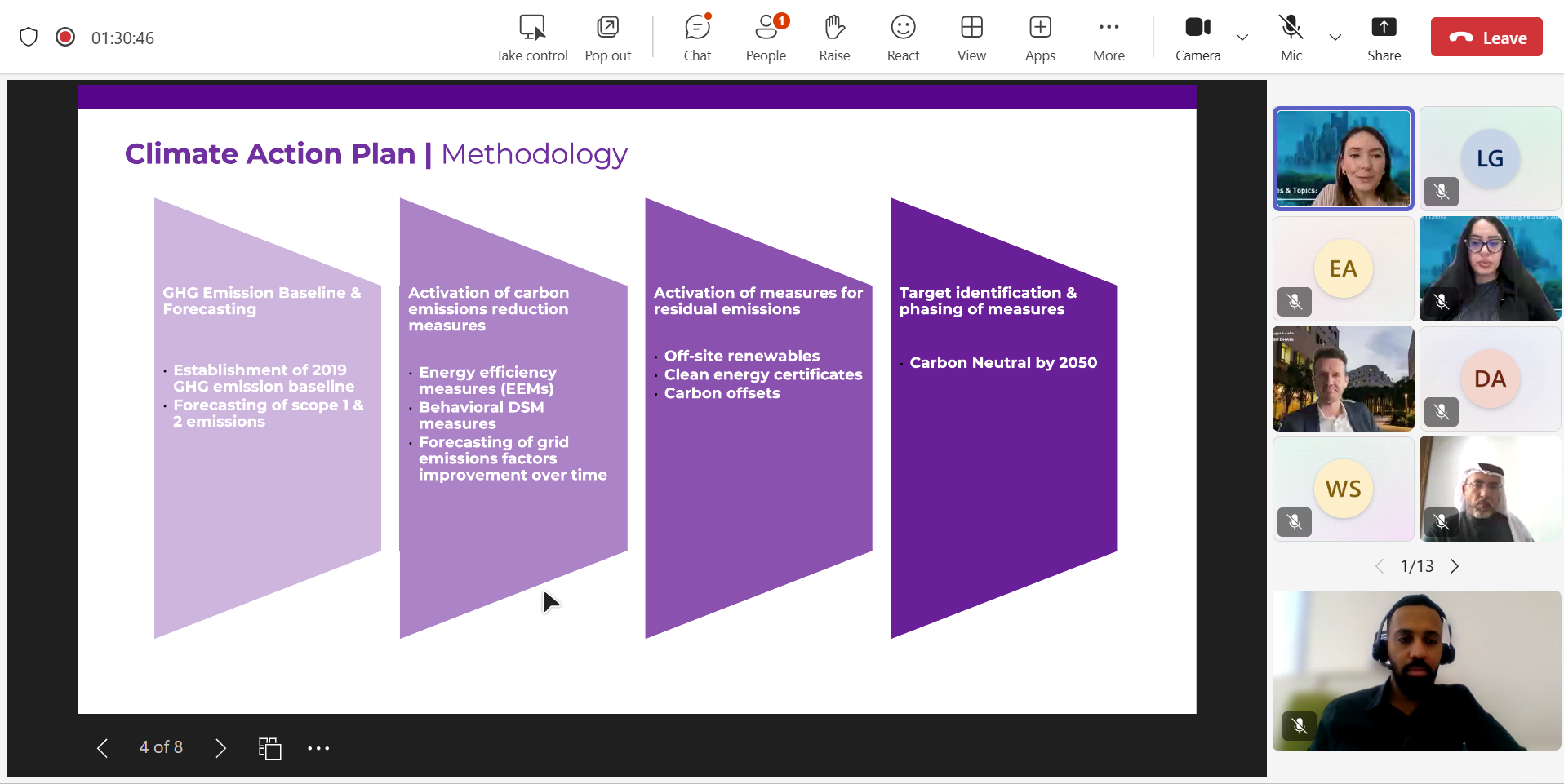
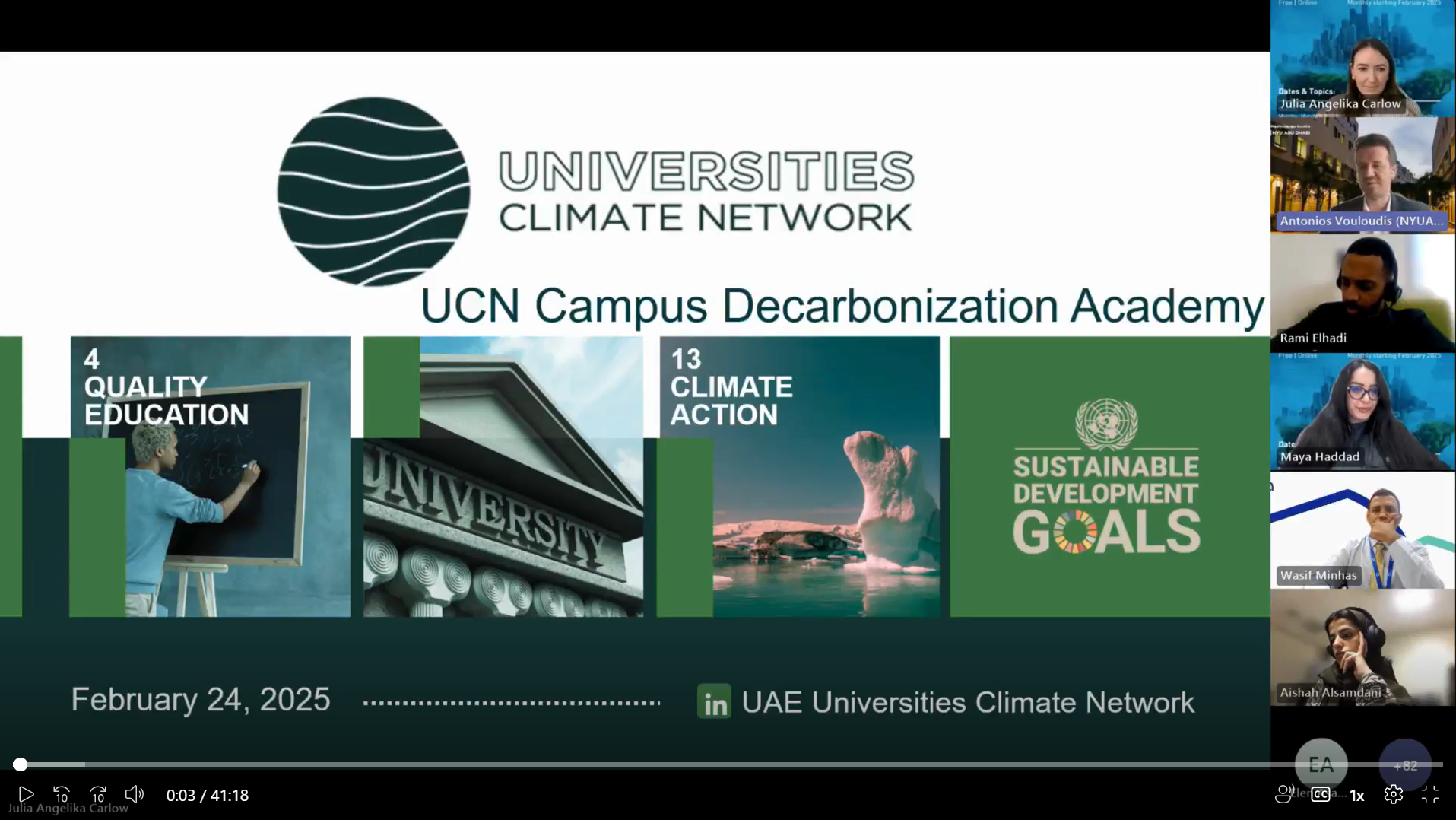
The UAE Universities Climate Network (UCN) Decarbonization Academy continued its first cycle with an essential session, "Drafting a Climate Action Plan for Higher Education Institutions," The workshop equipped participants with the strategic framework, guiding principles, and practical roadmap needed to guide their institutions toward carbon neutrality and net‑zero emissions—transforming climate ambition into measurable, long‑term action.
Hosted in line with the UAE's Year of Community 2025, the Academy is a collaborative initiative between Ajman University (AU), the American University of Sharjah (AUS), and New York University Abu Dhabi (NYUAD). The session was led by Mr. Antonious Vouloudis, Senior Director of Sustainability and Stewardship at NYUAD, who walked attendees through the core elements of a credible, living Climate Action Plan—from key assumptions and stakeholder management to behavioral demand‑side strategies and the careful use of carbon offsetting.
Why a Climate Action Plan Matters
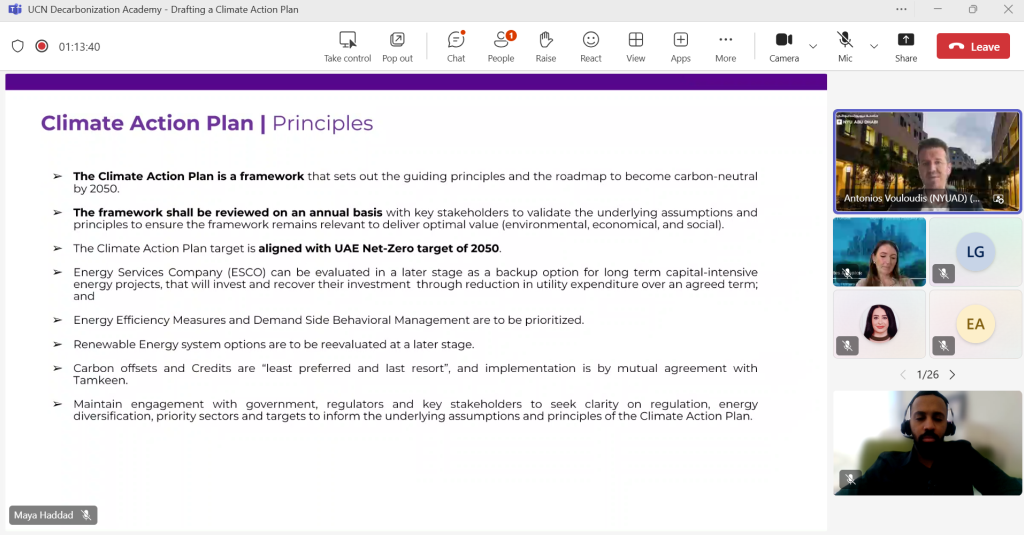
Mr. Vouloudis opened the session by framing the Climate Action Plan as a dynamic framework—not a static document—designed to guide institutions toward carbon neutrality by 2050, in full alignment with the UAE's Net Zero 2050 target. He emphasized that annual progress checks are essential to validate underlying assumptions, adapt to evolving technologies, and ensure the plan remains relevant across environmental, economic, and social dimensions. The session underscored that science‑based targets require a structured roadmap to align with global carbon budgets, respect climate tipping points, and respond to the urgency of the climate emergency.
Prioritizing Action: A Clear Hierarchy
A core focus of the workshop was establishing a clear and actionable hierarchy of climate action. Mr. Vouloudis stressed that carbon offsets and credits are the "least preferred and last resort," to be implemented only by mutual agreement with Tamkeen and after exhausting all internal reduction measures. Instead, institutions must prioritize:
-
Energy Efficiency Measures and Demand‑Side Behavioral Management as the first and most impactful steps.
-
Renewable Energy system options (including solar, wind, and future technologies such as green hydrogen and geothermal) to be reevaluated at a later stage.
-
Carbon Offsetting only as a final bridging measure, without assuming future cost reductions for solar or carbon credits.
Attendees learned that a successful Climate Action Plan must maintain continuous engagement with government regulators and key stakeholders—an essential component of climate diplomacy and climate mainstreaming—to seek clarity on regulations, energy diversification, and priority sectors.
Key Assumptions Underpinning the Framework
Mr. Vouloudis detailed the critical assumptions that shape NYUAD's Climate Action Plan, offering participants a practical checklist for developing their own institutional roadmaps:
-
Regular annual reviews to monitor progress, validate underlying principles, and adapt the framework during implementation.
-
Government-led regulatory development and deployment of suitable clean, affordable energy sources to enable the transition to Net Zero by 2050.
-
Industry evolution and technological innovation (including new renewable sources, carbon capture, utilization, and storage (CCUS), and direct air capture (DAC) in the future) to present sustainable transition opportunities.
-
Campus expansion reviews triggered by any significant change in use or footprint.
-
Nominal energy demand increase from the 2019 baseline year moving forward.
-
Emission factor improvements from EWEC and TABREED assumed until 2035, with no further improvement post‑2035 under the current scenario.
-
Offset measures based on current costs, without assuming lower future prices for solar or carbon credits.
Behavioral Demand‑Side Management: Action on the Ground
One of the most valuable segments of the session was a detailed breakdown of practical, community‑focused initiatives that require no capital investment yet deliver significant emissions reductions. Mr. Vouloudis shared NYUAD's approach to behavioral change, demonstrating that climate literacy and community engagement are powerful tools for decarbonization.
Examples included:
-
Residential Apartments Electrical Usage: Monthly monitoring to identify high and low energy users, development of a Tenant Guide, strategic partnership with the Department of Energy, setpoint restrictions, and end‑of‑life appliance replacement with efficient options.
-
Electric Vehicle Charging Stations: Charging users for access, enabling rotation of maximum users per station, reinvesting ROI into future sustainability initiatives, and encouraging community members to switch to electric cars—directly supporting sustainable mobility / low‑carbon transport and reducing Scope 3 emissions from transportation.
-
Water Strategy: Maximizing water refill stations across campus, minimizing single‑use plastic water bottles, and launching awareness campaigns to inform the community of available potable water sources—contributing to circular economy and zero waste principles.
-
Future Initiatives: Strategic partnerships with External Relations and student government to ensure clear, non‑overlapping messaging. Upcoming topics include water potability (myth‑breaking around microplastics in bottled water), food waste reduction (front‑of‑house minimization and nutritionist‑led sessions on vegetarian/vegan diets), waste recycling (myth‑breaking to maximize recycling rates), and student energy use (nudging in dorms in collaboration with student interest groups).
Real‑World Relevance: Beyond the Campus
Mr. Vouloudis also situated the Climate Action Plan within broader climate finance and accountability frameworks. He noted that while offset measures are based on today's costs, future decreases in solar pricing and carbon credits could improve affordability. The session touched on the potential role of Energy Services Companies (ESCOs) as a backup option for long‑term capital‑intensive energy projects, where external partners invest and recover their investment through reduced utility expenditure over an agreed term.
The workshop reinforced that robust Climate Action Plans help institutions prepare for emerging mechanisms such as the Carbon Border Adjustment Mechanism (CBAM) and align with corporate climate accountability and environmental, social and governance (ESG) criteria. By integrating nature‑based solutions (NbS)—such as afforestation/reforestation, blue carbon (mangroves, seagrasses, salt marshes), and ecosystem restoration—as complementary long‑term strategies, universities can build climate resilience, reduce climate vulnerability, and contribute to disaster risk reduction (DRR) and early warning systems at the institutional level.
Building a Just and Resilient Future
The session concluded with a powerful reminder that decarbonization must be pursued as a just transition—ensuring that climate action benefits all communities equitably and addresses loss and damage where it occurs. By embedding climate justice principles into their Climate Action Plans, higher education institutions can model climate‑resilient development and inspire broader societal change. Discussions also touched on the importance of methane reduction (from agriculture, waste, and oil/gas), black carbon mitigation, and the role of carbon sinks (forests, oceans, soil) in achieving negative emissions over the long term.
Looking ahead, the UCN Decarbonization Academy encourages universities to integrate their Climate Action Plans into long‑term low‑emission development strategies (LT‑LEDS) and nationally determined contributions (NDCs), aligning with the UAE's fossil fuel phase‑out ambitions. Climate finance mechanisms, including green bonds and carbon pricing (such as emissions trading schemes (ETS) or a carbon tax), were discussed as enablers for scaling up these efforts.
Looking Ahead
The UCN Decarbonization Academy continues to empower sustainability professionals across the UAE with the tools, frameworks, and collaborative spirit needed to turn ambition into measurable impact. Future sessions will build on this strategic foundation to explore targeted reduction pathways, data collection methodologies, and implementation strategies—all while keeping climate feedback loops, climate activism / grassroots movements, and corporate climate accountability firmly in view.