News
UCN Decarbonization Academy Navigates the Path to Measurable Climate Action with Data & Emissions Workshop
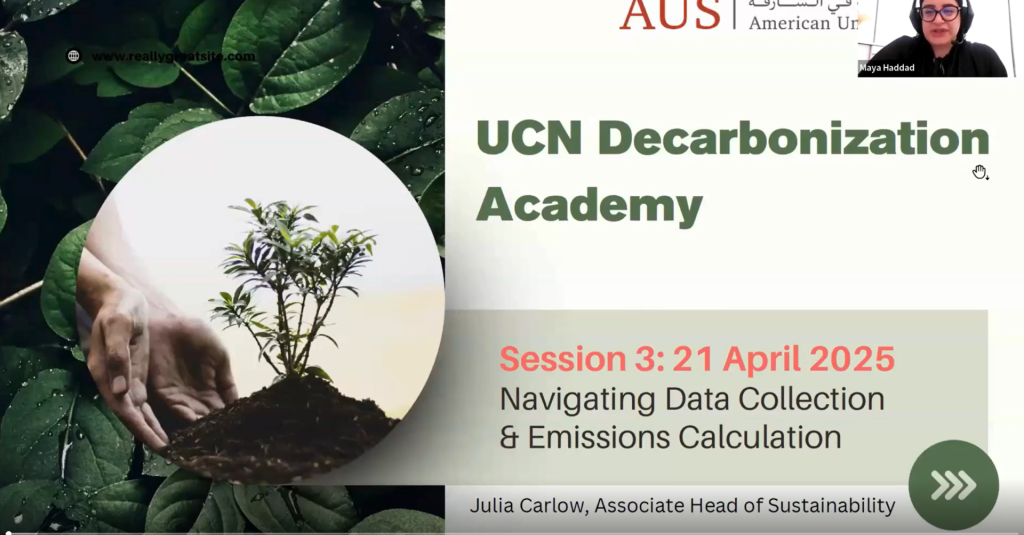
The UAE Universities Climate Network (UCN) Decarbonization Academy continued its first cycle with an essential third session, “Navigating Data Collection & Emissions Calculation in HEIs,” The workshop equipped participants with the technical know-how to measure, track, and manage institutional carbon footprints—a critical step toward carbon neutrality and net‑zero emissions.
Hosted in line with the UAE’s Year of Community 2025, the Academy is a collaborative initiative between Ajman University (AU), the American University of Sharjah (AUS), and New York University Abu Dhabi (NYUAD). The session was led by Mrs. Julia Carlow, Associate Head of Sustainability at the American University of Sharjah, who walked attendees through the complex but vital process of transforming raw data into actionable decarbonization strategies.
Why Measurement Matters
Mrs. Carlow opened the session by framing emissions accounting within a broader context, including international rankings and the upcoming UAE Climate Law (Federal Decree on the Reduction of Climate Change Effects), set to take effect in May 2025. She introduced the GHG Protocol Standard as the global gold standard for creating a true and fair account of an institution’s emissions, emphasizing its role in reducing costs, ensuring transparency, and enabling participation in both voluntary and mandatory climate programs. The session underscored that science‑based targets require reliable data to align with global carbon budgets and avoid climate tipping points.
Understanding the Three Scopes
A core focus of the workshop was demystifying the three scopes of emissions under the GHG Protocol:
-
Scope 1 (Direct Emissions): Stationary combustion (boilers, generators), mobile combustion (institution-owned vehicles), process emissions (agriculture), and fugitive emissions (refrigerant leaks from HVAC equipment). Discussions highlighted the importance of methane reduction and addressing black carbon where applicable.
-
Scope 2 (Indirect Emissions): Emissions from the generation of purchased electricity, steam, heat, or cooling. Participants noted that shifting to renewable energy (solar, wind, geothermal) and electrification of heating and transport are key levers for reducing Scope 2.
-
Scope 3 (Other Indirect Emissions): A comprehensive category including purchased goods and services, capital goods, water consumption, employee commute, sustainable mobility / low‑carbon transport, air travel, freight, waste disposal, downstream leased assets, franchises, investments, and fuel- and energy-related activities. This scope directly connects to circular economy principles and zero waste goals.
Who Collects What? A Practical Roadmap
One of the most valuable segments of the session was a detailed breakdown of responsible parties for data collection. Mrs. Carlow shared AUS’s internal model, demonstrating that successful GHG accounting requires cross-departmental collaboration. For example:
-
Facilities Departments manage stationary combustion and refrigerants.
-
Supply Chain & Finance oversee purchased goods, capital goods, and water consumption, aligning with corporate climate accountability and ESG criteria.
-
Transportation & Security provide data on employee commute and fleet emissions, informing low‑carbon transport policies.
-
Third-party travel agencies and contractors contribute data on air travel and freight.
Real-World Results & Key Challenges
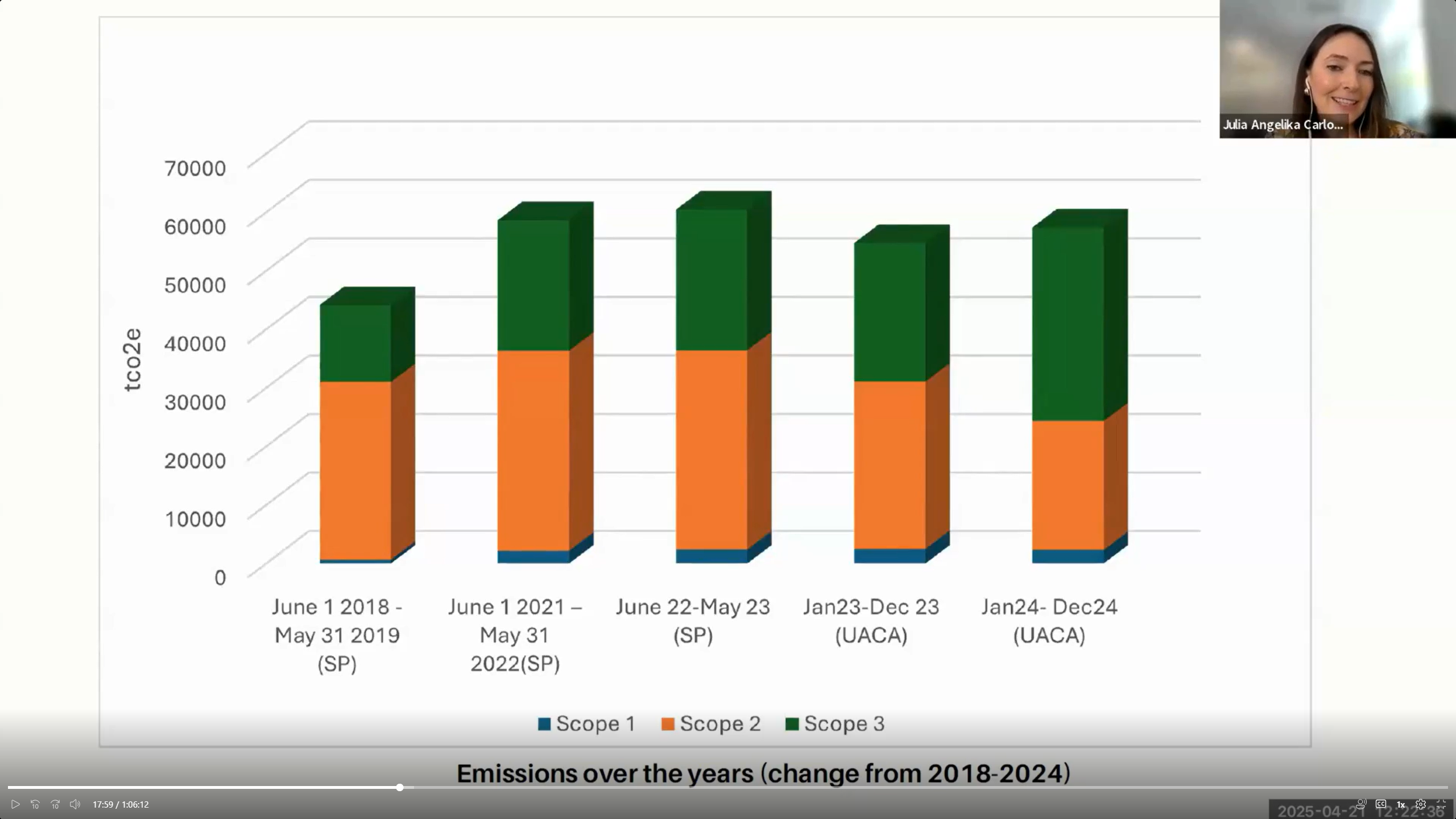
Participants were presented with AUS’s 2024 emissions data, which revealed a total footprint of 57,387 tCO2e (Scope 1: 2,300 tCO2e; Scope 2: 22,024 tCO2e; Scope 3: 33,063 tCO2e). Notably, Scope 2 emissions continued to decline due to ongoing energy efficiency initiatives and the adoption of the DEWA emissions factor. Meanwhile, Scope 3 emissions increased—not necessarily due to worsened performance, but due to better quality data from food outlets, IT purchases, and advertising costs—highlighting how improved measurement supports climate mainstreaming and informed climate adaptation plans.
Mrs. Carlow also candidly addressed key challenges facing higher education institutions:
-
Fragmented Data scattered across departments and systems.
-
Inconsistent Data Quality leading to compromised reporting integrity.
-
Manual Processes in spreadsheets, resulting in errors and administrative burden.
-
Limited Employee Engagement without proper training, underscoring the need for climate literacy and behavioural change.
Building a Data-Driven Decarbonization Strategy
The session reinforced that robust data collection is not an end in itself, but the foundation for effective decarbonization. By understanding their emissions baseline and where data gaps exist, institutions can prioritize interventions—from energy efficiency retrofits to sustainable procurement and circular economy practices. The workshop also touched on the role of carbon offsetting only after deep reductions, and the importance of negative emissions technologies such as direct air capture (DAC) and nature‑based solutions (e.g., afforestation, blue carbon in mangroves and seagrasses) as complementary tools.
Looking ahead, the Academy encourages universities to integrate their GHG inventories into long‑term low‑emission development strategies (LT‑LEDS) and nationally determined contributions (NDCs) , aligning with the UAE’s fossil fuel phase‑out ambitions and climate‑resilient development goals. Climate finance mechanisms, including green bonds and carbon pricing (such as emissions trading systems or a carbon tax), were discussed as enablers for scaling up these efforts.
The UCN Decarbonization Academy continues to empower sustainability professionals across the UAE with the tools, frameworks, and collaborative spirit needed to turn ambition into measurable impact. Future sessions will build on these foundational data skills to explore targeted reduction strategies and implementation pathways, with an emphasis on climate justice and a just transition that leaves no community behind.
About the UCN Decarbonization Academy
Launched in mid-2024, the Academy is a flagship initiative under the University Climate Network’s carbon neutrality pillar. The first cycle features expert-led workshops by AU, AUS, and NYUAD, covering climate action planning, carbon literacy, emissions calculation, and energy efficiency.