News
Introduction to Carbon Literacy: UCN Decarbonization Academy Equips Participants with Essential Climate Knowledge
The Universities Climate Network (UCN) Decarbonization Academy continued its first cycle with an essential second session, "Introduction to Climate and Carbon Literacy," The workshop equipped participants with the foundational knowledge needed to understand Earth's climate system, distinguish between urgent facts and misinformation, and begin measuring their own carbon footprint—a critical first step toward meaningful climate action and net‑zero emissions.
Hosted in line with the UAE's Year of Community 2025, the Academy is a collaborative initiative between Ajman University (AU), the American University of Sharjah (AUS), and New York University Abu Dhabi (NYUAD). The session was led by Ms. Maya Haddad, Senior Sustainability Manager at Ajman University, who walked attendees through the essential principles of climate science, the urgent drivers of the climate emergency, and the practical vocabulary required to engage confidently in decarbonization efforts.
Why the Urgency?
Ms. Haddad opened the session by confronting participants with the stark reality of record‑breaking temperatures, melting ice caps, extreme weather patterns, droughts, ocean acidification, and cascading ecosystem failures. She emphasized that climate change is not a distant future threat but a present-day crisis with profound impacts on human health—including increased heat‑related illnesses, worsened air quality, the spread of infectious diseases, food and waterborne illnesses, and escalating mental health challenges.
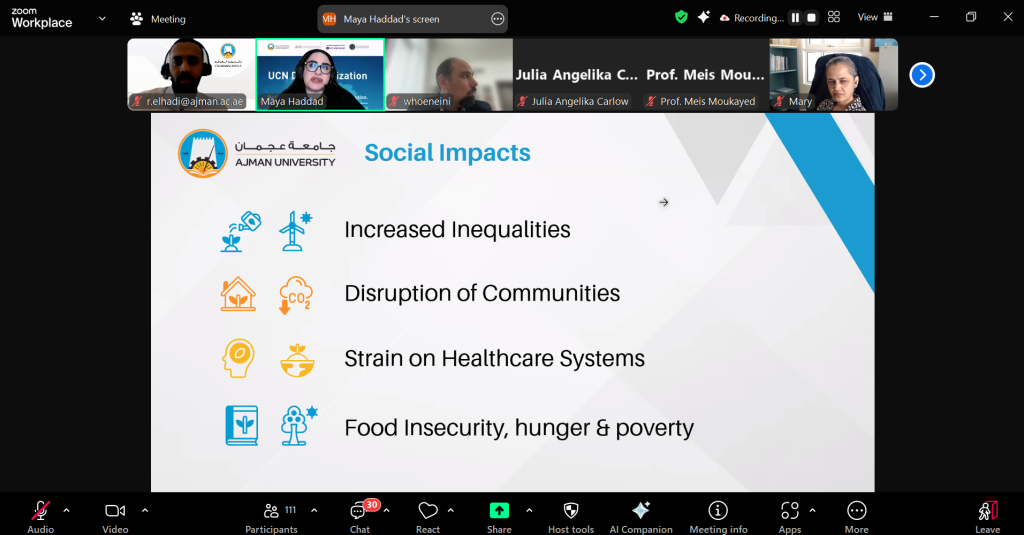
The session also explored the deep social impacts of climate change, including increased inequalities, disruption of communities, strain on healthcare systems, and rising food insecurity, hunger, and poverty. On the economic front, participants learned about agricultural impacts, job losses, resource scarcity, and disruptions to businesses and supply chains. This comprehensive framing reinforced that climate vulnerability touches every dimension of human well‑being.
What Is Climate Literacy?
A core focus of the workshop was defining and demystifying climate literacy. Ms. Haddad explained that climate literacy is the understanding of essential principles of Earth's climate system, including:
-
Understanding the Sun's energy and its influence on Earth's climate.
-
Knowing how natural processes and human activities affect the climate.
-
Comprehending the impacts of climate change on society and ecosystems.
-
Being able to make informed decisions about climate change mitigation and adaptation.
The session underscored that climate literacy is now a fundamental skill for navigating the challenges of the 21st century. It supports the development of effective solutions and policies, enables informed decision‑making at individual and policy levels, fosters a sense of shared responsibility, empowers action, helps distinguish credible scientific information from misinformation, and contributes to a more sustainable and climate‑resilient future.
Your Climate Dictionary: Essential Terms
One of the most valuable segments of the session was a clear, accessible breakdown of essential climate terminology. Ms. Haddad walked participants through key distinctions:
-
Weather vs. Climate: Weather is atmospheric conditions at a specific time and location. Climate is the average of weather patterns over 30 or more years, representing the overall state of the climate system.
-
Global Warming vs. Climate Change: Global warming refers to the rise in Earth's average surface temperature due to increased greenhouse gas concentrations. Climate change encompasses long‑term changes affecting the atmosphere, ocean, and land, including sea level rise, coastal erosion, glacier melting, and extreme weather events.
-
Climate Change Mitigation: Actions taken by governments, businesses, and individuals to reduce, sequester, or prevent greenhouse gas emissions—including transitioning to renewable energy (solar, wind, hydro), investing in carbon‑free transportation, promoting sustainable agriculture, planting forests, and altering consumption practices.
-
Climate Change Adaptation: Actions to reduce vulnerability to climate change impacts, such as planting drought‑resistant crops, building flood defenses, relocating infrastructure, and developing specific insurance mechanisms.
-
Nature‑based Solutions (NbS): Actions that use natural systems and processes to restore ecosystems, conserve biodiversity, and enable sustainable livelihoods—including green roofs, urban parks, restoring wetlands, conserving mangrove forests (blue carbon), and switching to regenerative farming practices.
-
Loss and Damage: The unavoidable impacts of climate change despite mitigation and adaptation efforts, including economic losses (rebuilding infrastructure) and non‑economic losses (trauma, loss of life, displacement, loss of history, culture, or biodiversity).
-
Paris Agreement: A legally binding international treaty adopted by 196 Parties at COP21 in 2015, aiming to limit global warming to below 2°C, preferably 1.5°C, compared to pre‑industrial levels.
What Is Carbon Literacy?
Building on climate literacy, Ms. Haddad introduced carbon literacy as a focused subset of knowledge:
-
Awareness of the impact of our activities on the climate, specifically through greenhouse gas emissions.
-
Understanding the concept of a "carbon footprint"—the total greenhouse gas emissions caused directly and indirectly by an individual, organization, event, or product.
-
Knowing the main sources of carbon emissions (e.g., burning fossil fuels for energy, transportation, agriculture, industrial processes).
The session highlighted that carbon literacy allows individuals and organizations to identify their main emission sources, make informed choices to reduce their carbon footprint, adopt sustainable practices and technologies, support the transition to a low‑carbon economy, and contribute to achieving national and international climate goals.
Understanding Emission Sources and Scopes
Participants were guided through the primary sources of greenhouse gas emissions:
-
Energy (electricity and heat production): The largest contributor to global emissions.
-
Transportation: Road transport burning gasoline or diesel, air travel, shipping, and freight.
-
Industrial sector: Production of cement, steel, plastics, and chemicals.
-
Agriculture and Land Use: Methane emissions from livestock, nitrous oxide from fertilizers, and deforestation.
-
Buildings: Electricity used for lighting, heating, and cooling in residential and commercial buildings.
Ms. Haddad then introduced the Greenhouse Gas Protocol's three scopes of emissions—a critical framework for measuring carbon footprints consistently and comparably:
-
Scope 1 (Direct Emissions): Emissions from sources an organization owns or controls directly, such as burning fuel in company vehicles or on‑site boilers.
-
Scope 2 (Indirect Emissions – Electricity): Emissions from the generation of purchased electricity, steam, heat, or cooling consumed by the organization.
-
Scope 3 (Other Indirect Emissions – Value Chain): All other indirect emissions occurring in an organization's value chain, including purchased goods and services, transportation of goods, employee commuting, and end‑of‑life treatment of sold products—often the largest and most complex scope.
Your Carbon Dictionary: Key Concepts
The session concluded with a practical carbon dictionary, equipping participants with essential terms for their decarbonization journey:
-
Decarbonization: Reducing greenhouse gas emissions and increasing their absorption, requiring significant investments in low‑carbon infrastructure, renewable energy, circular economy, resource efficiency, and land and soil restoration.
-
Carbon Markets: Pricing mechanisms enabling governments and non‑state actors to trade greenhouse gas emission credits, including compliance markets (regulated) and voluntary markets (where companies, cities, or regions voluntarily offset emissions).
-
Carbon Credits: Certificates representing a volume of carbon dioxide equivalent reduced during a specific period, allowing the holder to emit an equal amount within their operations.
-
Net‑Zero: Ensuring that carbon dioxide emissions from human activity are balanced by human efforts to remove carbon dioxide (e.g., creating carbon sinks such as forests, oceans, and soil), thereby stopping further increases in greenhouse gas concentrations. Transitioning to net‑zero requires a complete transformation of energy, transportation, production, and consumption systems.
The Path to Net‑Zero
Ms. Haddad outlined the key pathways for achieving net‑zero emissions, including:
-
Transitioning to renewable energy sources (solar, wind, hydro, geothermal, tidal).
-
Improving energy efficiency in buildings (green buildings, retrofitting, building management systems).
-
Carbon capture, utilization, and storage (CCUS) technologies.
-
Sustainable land use practices, including forest conservation and reforestation.
-
Sustainable agriculture and urban planning.
-
Promoting electric vehicles and developing EV charging infrastructure (sustainable mobility / low‑carbon transport).
Real‑World Relevance: Policy and Resources
The session also grounded carbon literacy in the UAE's evolving policy landscape. Ms. Haddad highlighted several key resources for participants to explore further:
-
UAE Federal Decree‑Law on the Reduction of Climate Change Effects (coming into effect in May 2025).
-
Law No. (11) of 2024 establishing the Dubai Environment and Climate Change Authority.
-
National Climate Change Plan of the United Arab Emirates.
-
UAE Climate Risk Assessment & Adaptation Measures in Key Sectors.
-
National Adaptation Plan Roadmap for the United Arab Emirates.
-
A Guide to Climate Action in the UAE.
-
Kyoto Protocol and The Paris Agreement.
Looking Ahead: From Literacy to Action
The session concluded with a powerful reminder that climate and carbon literacy are not academic exercises but the essential foundation for all subsequent climate action. Without understanding the urgency, the vocabulary, and the measurement frameworks, institutions cannot set science‑based targets, align with global carbon budgets, or avoid climate tipping points. By fostering climate literacy across campuses, the UCN Decarbonization Academy is building a community of practice equipped to navigate climate feedback loops, support a just transition, embed climate justice principles, and drive corporate climate accountability through robust environmental, social and governance (ESG) frameworks.
The UCN Decarbonization Academy continues to empower sustainability professionals across the UAE with the tools, frameworks, and collaborative spirit needed to turn ambition into measurable impact. Future sessions will build on this foundational literacy to explore emissions calculation, climate action planning, and sector‑specific reduction strategies—all while keeping climate activism, grassroots movements, and the principles of a just transition firmly in view.