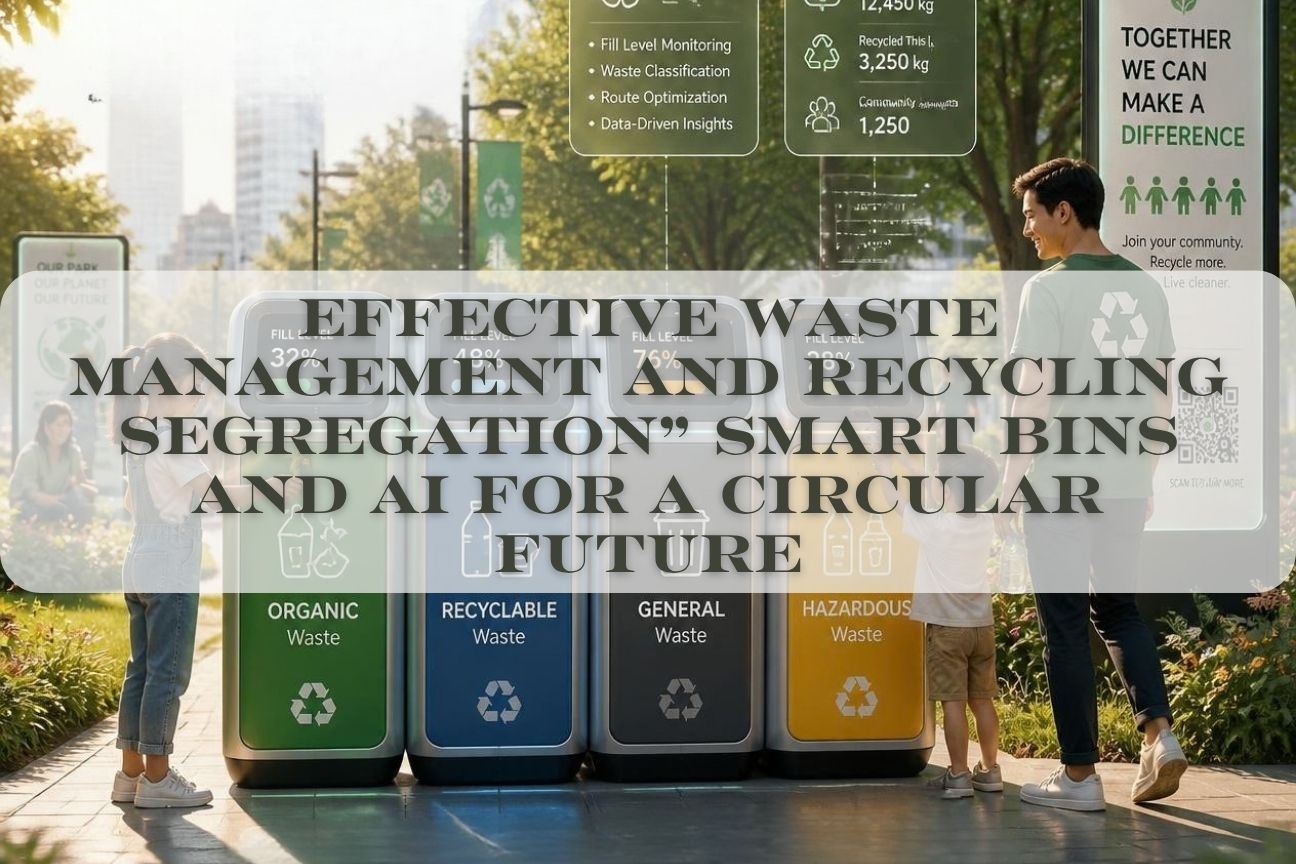
Student Project Spotlight: “Effective Waste Management and Recycling Segregation” Smart Bins and AI for a Circular Future
A new student research project at Ajman University is tackling the global waste crisis through an innovative combination of artificial intelligence, smart technology, and community-driven incentives. Titled “Effective Waste Management and Recycling Segregation,” the project is described as a comprehensive solution that uses AI-powered smart bins and reverse vending machines to automatically sort waste at the source. At its core is a mobile application that connects users to a reward system, turning everyday recycling into a gamified, rewarding experience.
The project, developed by students Hurairah Faatimah Muzammil, Jon Regala, Khadeeja Hashim, and Mohammed Bayan, addresses a critical issue: when waste isn’t separated, everything ends up in landfills, polluting soil and water while releasing methane from rotting organic matter. Manual segregation is often confusing, inconsistent, and time-consuming. To solve this, the team proposes AI-driven segregation that can identify plastic, paper, glass, metal, organic waste, and even medical waste with high precision, speed, and safety. These smart bins are linked to a mobile app where users earn points based on what they dispose of. The system makes points type-dependent, meaning eco-friendly waste like biowaste generates more points than single-use plastics actively encouraging users to reduce their consumption of unsustainable products.
Beyond collection, the project explores creative pathways for the segregated waste. Organic waste can be converted into bioplastics, natural compost, or used for waste-to-energy through anaerobic digesters. Electronic waste can be upcycled into circuit board jewelry or DIY STEM kits. Plastics can be shredded into 3D printing filament, combined into plastic-wood composites for furniture, or used to create eco-bricks and art installations. The team also highlights circular economy design, such as closed-loop product lines where old items are returned for redesign or points.
Supporting SDG 13: Climate Action
This project directly supports Sustainable Development Goal 13 by reducing greenhouse gas emissions associated with landfill waste. When organic waste decomposes anaerobically in landfills, it produces methane a greenhouse gas 84 times more potent than CO₂ over a 20-year period. By segregating and composting organic waste, the project prevents these emissions while producing valuable compost that improves soil health. Furthermore, by recycling materials like plastic, glass, and metal, the system reduces the energy and carbon emissions required to extract and process virgin materials. The AI-driven reward system encourages long-term behavioral change, making sustainable waste management an accessible and rewarding part of daily life. The project also aligns with SDG 11 (Sustainable Cities and Communities), SDG 12 (Responsible Consumption and Production), and SDG 9 (Industry, Innovation and Infrastructure).
Keywords: waste segregation, AI smart bins, reverse vending machines, SDG 13, Climate Action, circular economy, recycling, methane reduction, sustainable waste management, gamification, bioplastics, e-waste upcycling, Ajman University, student innovation.
To view the project, click here.