ICARDA
Ajman University's Partnership with ICARDA: The Desert Bloom Project
The partnership between Ajman University and the International Center for Agricultural Research in the Dry Areas (ICARDA) represents a direct translation of strategic climate dialogue into tangible, on-the-ground action. ICARDA is a global, non-profit research-for-development organization supported by the CGIAR. Established in 1977, its mission is to reduce poverty, enhance food, water, and nutritional security, and improve environmental health in the world's dry areas. It holds a global mandate for improving crops like barley, lentil, and faba bean, and focuses on critical areas such as on-farm water-use efficiency and climate change adaptation.
The collaboration was forged during a strategic national moment. In May 2023, Ajman University representatives participated in a consultation workshop for the UAE National Climate Change Adaptation Plan (NAP), convened by the Ministry of Climate Change and Environment (MOCCAE) in collaboration with the Global Green Growth Institute (GGGI). It was at this event that they connected with ICARDA, which was already conducting extensive research on climate-resilient agricultural models in partnership with MOCCAE. Recognizing the alignment between ICARDA's expertise and Ajman University's commitment to sustainability, the two entities conceived a bold vision: to pilot a solar-powered hydroponic net house at the university, creating a living laboratory for sustainable agriculture, experiential education, and community engagement.
This vision materialized as the "Desert Bloom: The Foodprint Project": a Solar Hydroponic Net House designed as an Arid-Climate Model for Food Security, Experiential Learning, and Community Impact. The project began with a pilot phase in 2024 to test and refine hydroponic and solar technologies in the UAE's extreme desert climate. Building on its success, the initiative transitioned to a full-scale, fully operational net house in 2025, becoming the UAE's first university-based facility of its kind.
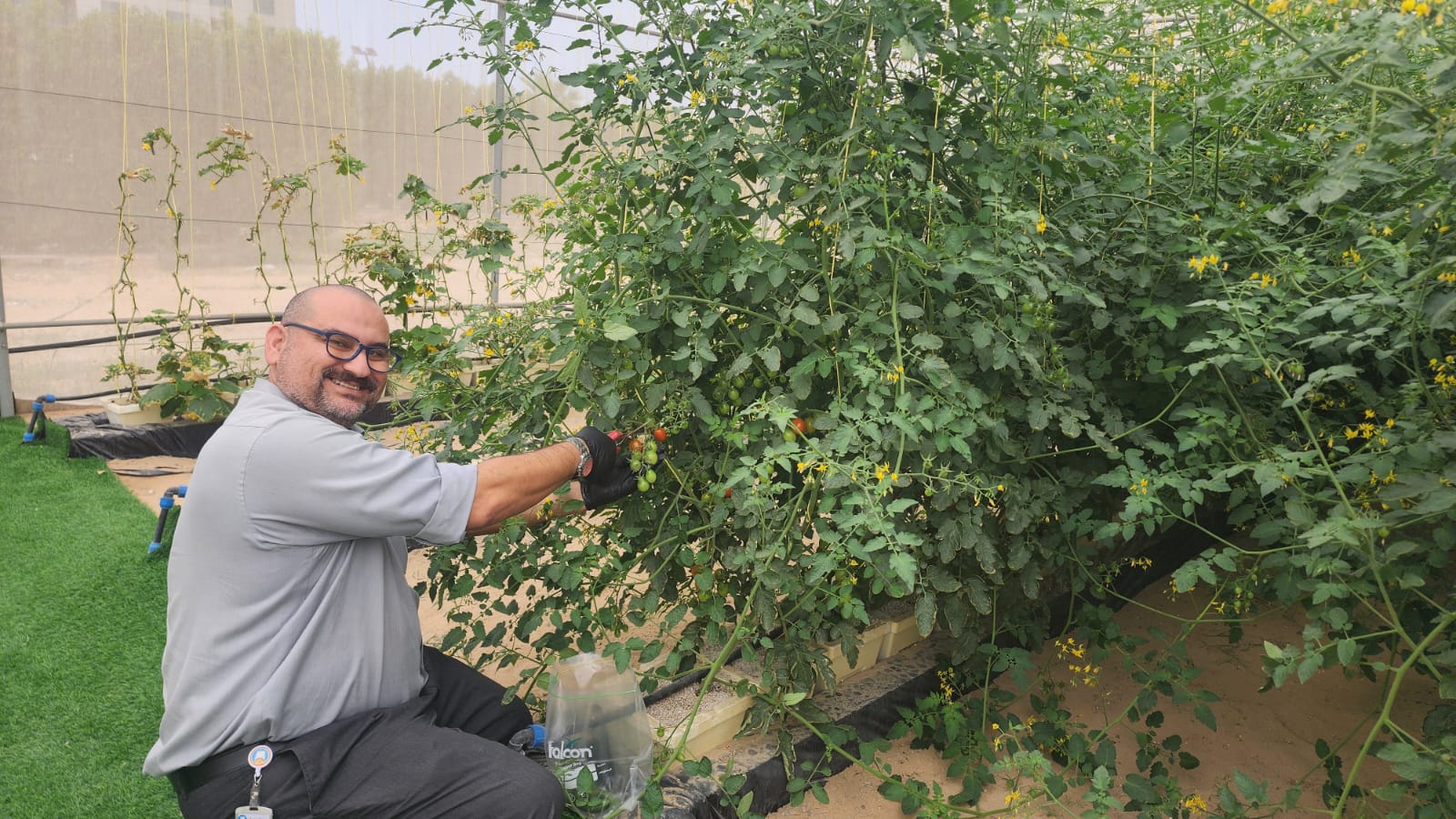
The facility integrates several of ICARDA's key innovations for desert farming, including insect-proof net houses, closed hydroponic systems, root-zone cooling, ultra-low-energy drip irrigation, and low-cost solar energy. These technologies enable year-round cultivation despite the UAE's punishing summer heat while using a fraction of the water and land required by traditional farming. ICARDA's research has demonstrated that such integrated systems can achieve yields surpassing regional open-field benchmarks while using significantly less water.
The impact of the project is tangible and community-centered. Across the pilot and first full-scale planting cycle, the facility has harvested over half a ton of organic cucumbers and cherry tomatoes. Every kilogram has been distributed free of charge to the entire Ajman University community—students, faculty, staff, external visitors, schoolchildren, and families. This is not a demonstration plot; it is a working farm producing real food for real people. Beyond food production, the net house serves as a resource for students and visitors, unlocking opportunities for research and exploration in drought-resilient crops and sustainable agriculture practices.
The Desert Bloom project exemplifies how academic institutions and international research centers can collaborate to advance national climate adaptation goals. It embodies Ajman University's commitment to technological innovation and its crucial role in advancing a new era of agriculture in the UAE, while also contributing to ICARDA's mission of developing practical, low-cost technologies that increase productivity in drylands while protecting fragile ecosystems. As the project continues to grow, it holds the potential to evolve into a regional research hub, offering a scalable blueprint for sustainable food production in hyper-arid environments.