“SADA” Using AI-Powered Acoustics to Protect UAE’s Marine Ecosystems
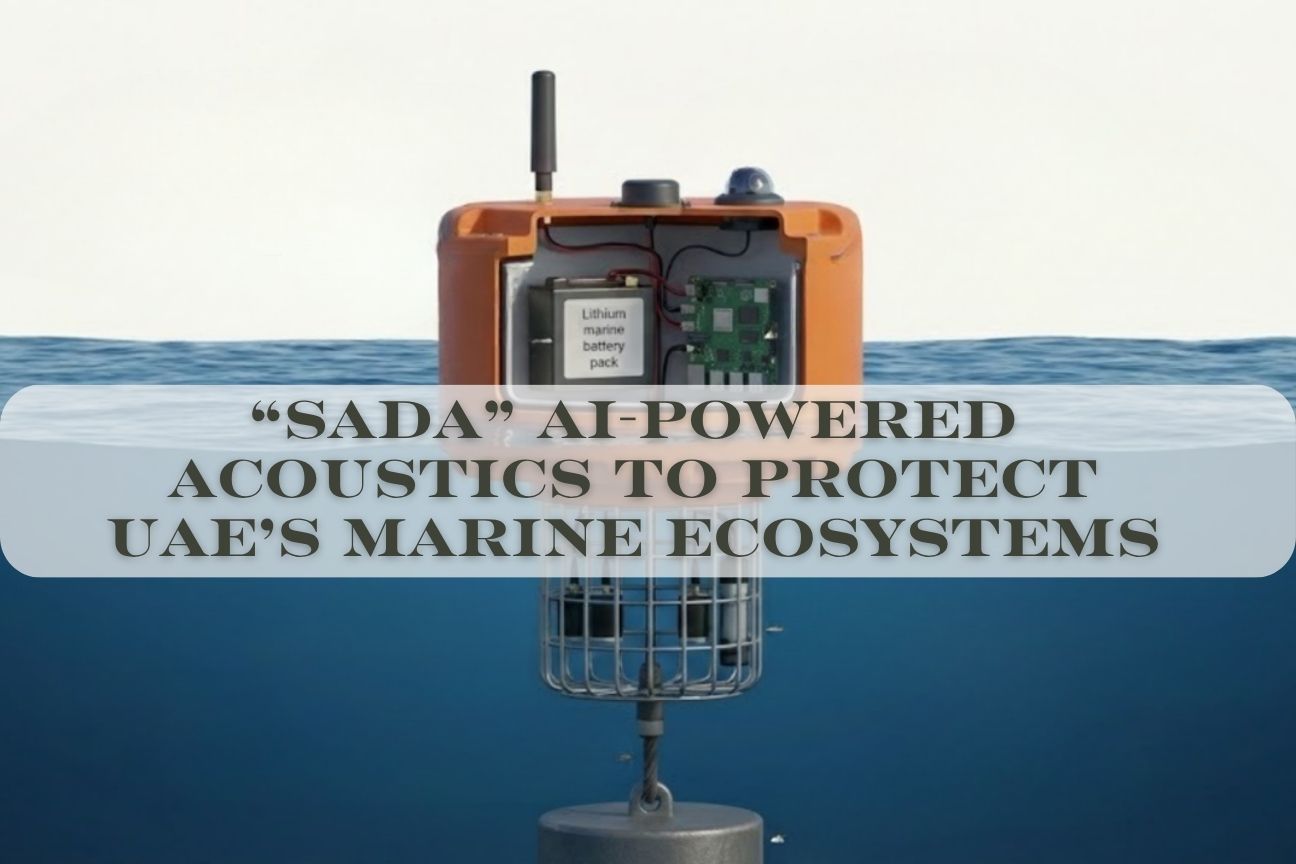
Student Project Spotlight: “SADA” Using AI-Powered Acoustics to Protect UAE’s Marine Ecosystems
A new student research project developed at Ajman University is transforming how the UAE monitors and protects its marine environment. Titled “SADA” (صدى), which translates to “Echo” in Arabic, the project is an autonomous, AI-powered marine environmental surveillance network designed to support ecosystem protection and compliance management within the UAE’s maritime borders. Developed by students Doaa Rafeq Al Alimi, Sara Walthan Al Jebori, and Muneera Kamil Yahya Ahmed, under the supervision of Office of Sustainability, the project was created for the Artificial Intelligence Applications in Sustainability domain.
The project addresses critical gaps in marine monitoring. Traditional surveillance relies heavily on AIS/GPS tracking and manual patrols, which fail to detect illegal, unreported, and unregulated (IUU) fishing vessels that intentionally disable their trackers to enter protected zones. Over 70% of the UAE’s commercial fish stocks are currently overexploited, with key species like hamour and kingfish seeing declines of up to 80% over the past three decades. Furthermore, seasonal ban violations and silent ecological shifts, such as changes in pH, dissolved oxygen, and turbidity often go unnoticed due to limited real-time data.
The SADA system introduces a shift from reactive monitoring to proactive, data-driven protection. Each autonomous floating node is equipped with high-sensitivity hydrophones and multi-parameter environmental probes. The core innovation lies in its Hierarchical Edge AI architecture. It uses unsupervised machine learning (Isolation Forests) to detect water quality anomalies and deep learning (MobileNetV2 CNNs) to classify acoustic signals. By processing complex data locally on the device, SADA transmits only validated alerts, significantly minimizing power consumption and extending the battery life of the nodes.
The project’s results demonstrate high accuracy in real-time simulations. The Random Forest model successfully classified commercial vessels, small unauthorized fishing boats, and background ocean noise. When the geospatial logic confirms an empty coastline, the system activates its deep learning model to identify endangered marine mammals, successfully detecting species such as the False Killer Whale with 82.4% confidence. The SADA dashboard also showcases intelligent power management, placing heavy neural networks into "sleep mode" when acoustic interference from multiple ships is detected, reserving computational power for actionable intelligence.
Supporting SDG 13: Climate Action
While SADA is deeply rooted in SDG 14 (Life Below Water), it directly supports SDG 13: Climate Action by enhancing the resilience of marine ecosystems against climate-induced stressors. The Arabian Gulf is one of the most ecologically stressed marine regions, warming at nearly 0.6°C per decade. By providing continuous monitoring of sea surface temperatures, dissolved oxygen, and biodiversity, SADA enables early warning alerts for hypoxic events and ecosystem degradation key climate adaptation strategies. By safeguarding marine biodiversity and preventing overfishing, the project helps maintain the ocean's capacity to sequester carbon (blue carbon) and protects the economic stability of the UAE’s Blue Economy for future generations. It also aligns with SDG 2 (Zero Hunger) through food security and SDG 9 (Industry, Innovation and Infrastructure) through its advanced AI application.
Keywords: SADA, marine conservation, AI-powered surveillance, SDG 13, Climate Action, Edge AI, acoustic monitoring, IUU fishing, biodiversity protection, ocean health, sustainable fisheries, blue economy, Ajman University, student innovation.
To view the project, click here.