“SSPN” Smart Solar Pedestrian Nodes for Sustainable Urban Infrastructure
“SSPN” Smart Solar Pedestrian Nodes for Sustainable Urban Infrastructure
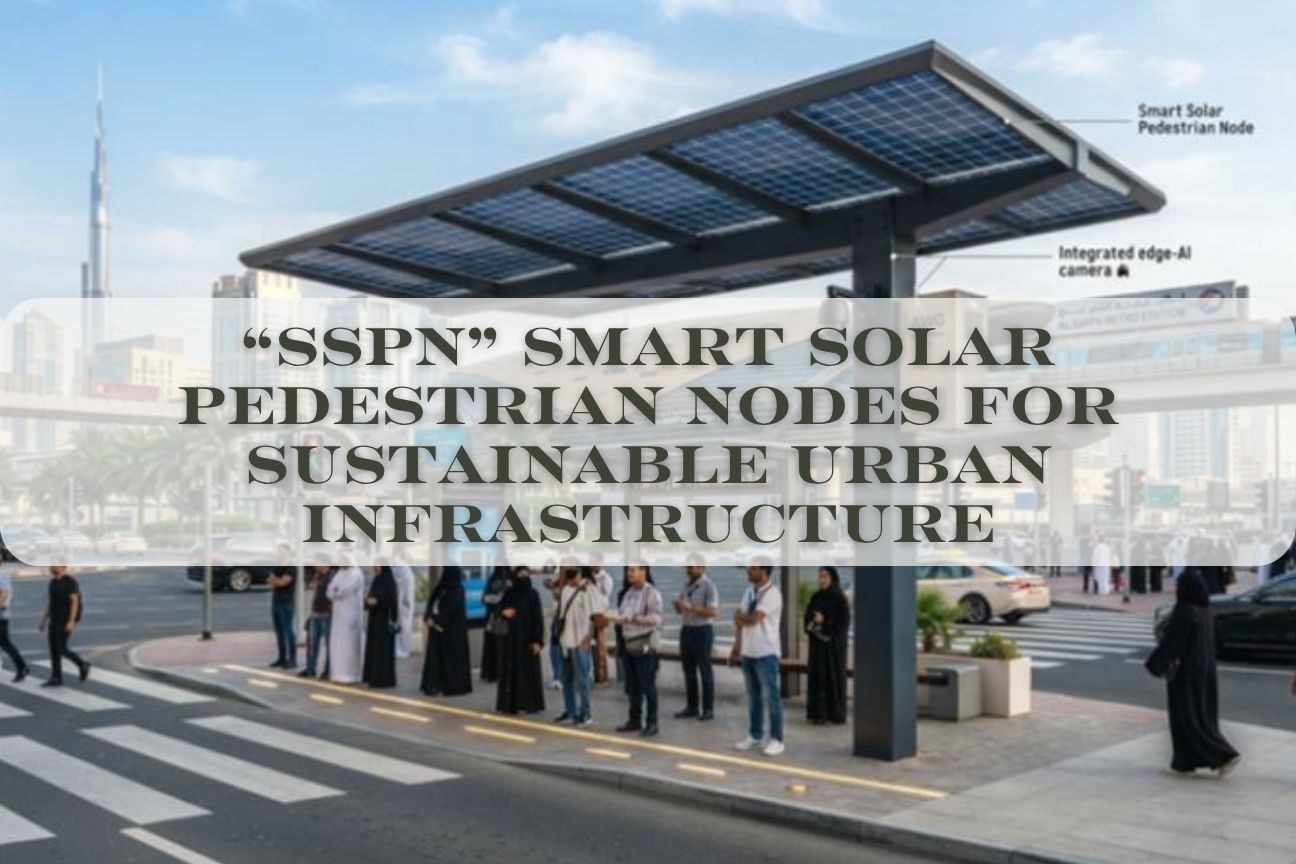
A new feasibility study developed at Ajman University is reimagining urban pedestrian crossings as active, sustainable infrastructure. Titled “SSPN” (Smart Solar Pedestrian Nodes), the project proposes retrofitting existing signal-controlled crossings in Dubai with self-powered, sensing, and shading units that generate clean energy, harvest water from ambient humidity, and use edge AI to improve pedestrian safety all without expanding the physical footprint.
The study addresses a critical urban challenge: pedestrian crossings currently represent unused real estate that offers no energy generation, no data collection, and no protection from extreme heat, which exceeds 45°C for roughly four months of the year in Dubai. The SSPN solution integrates a bifacial solar PV canopy that shades the waiting area and generates net-positive electricity, an atmospheric water generation (AWG) unit that condenses humidity for panel cleaning and irrigation, and an edge AI vision system that processes crowd density and wait times locally discarding frames on-device to preserve privacy. The node also includes automatic priority for People of Determination (POD) through wheelchair and white cane detection, extending green phases within RTA’s safety envelope. A central dashboard with a drag-and-drop, button-only workflow builder allows operators to configure rules without coding, reducing human error.
The project aligns directly with Dubai’s 2040 Urban Master Plan, Clean Energy Strategy 2050, and RTA’s Smart Transport and Vision Zero objectives. By turning existing crossing poles into distributed generation points and data nodes, SSPN supports walkability, heat safety, and inclusive mobility for vulnerable commuters.
Supporting SDG 13: Climate Action
This project directly supports Sustainable Development Goal 13 by advancing renewable energy generation and energy efficiency in urban infrastructure. The solar canopy produces clean electricity that can be exported to the local grid, reducing reliance on fossil-fuel power. The AWG unit uses condensation to clean panels and irrigate streetscape planting, closing a maintenance loop that improves PV yield and conserves water—a critical resource in the Gulf. By mitigating urban heat exposure and promoting active mobility, SSPN also reduces the carbon footprint associated with private vehicle use. It aligns with SDG 11 (Sustainable Cities and Communities), SDG 9 (Industry, Innovation and Infrastructure), and SDG 6 (Clean Water and Sanitation). The project demonstrates how student innovation can deliver practical, scalable climate solutions for the UAE’s net-zero ambitions.
Keywords: SSPN, smart solar pedestrian node, renewable energy, urban heat island, edge AI, atmospheric water generation, SDG 13, Climate Action, sustainable cities, Dubai 2040, RTA, Ajman University, student innovation.
To view the project, click here.