News
Ajman University Champions Green Education at COP30: Maya Haddad Joins Global Call for Urgent Action
Ajman University’s Sustainability Manager represented the institution at the COP30 climate conference in Belém, Brazil, reinforcing AU’s commitment to the UNESCO Greening Education Partnership and the global push to make half of all schools green by 2030.
As world leaders gathered for the 30th Conference of the Parties (COP30) in Belém, Brazil, UNESCO issued an urgent call to accelerate the transformation of schools into green institutions. New data released ahead of the conference revealed that 96,000 schools across 93 countries have already adopted UNESCO-recommended green practices, yet the Organisation warned that progress remains uneven and must be dramatically scaled up to meet the target of 50% of schools in every country becoming green by 2030.
Representing Ajman University at this pivotal global forum was Ms. Maya Haddad, the university’s Senior Sustainability Manager, who has been at the forefront of AU’s environmental leadership. Haddad joined the Ajman University delegation at COP30, where she participated in high-level discussions on climate education, youth engagement, and the role of higher education in advancing the sustainability agenda.
A Global Platform for Green Schools
The UNESCO call to action was presented during the COP30 Ministerial Roundtable on greening education, co-hosted by Brazil’s Minister of Education and UNESCO. The roundtable brought together policymakers, educators, and institutional leaders to exchange best practices on integrating environmental issues into curricula, strengthening teacher training, and fostering inter-ministerial collaboration.
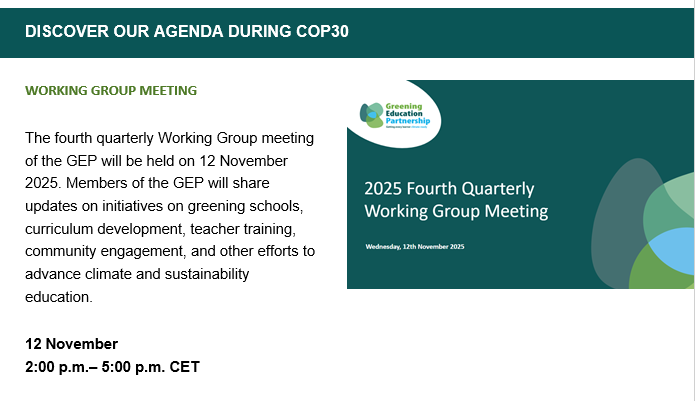
Central to these efforts is the Greening Education Partnership (GEP), a global initiative launched at the UN Transforming Education Summit in 2022. The partnership now counts 97 countries and 1,900 stakeholders among its signatories. Ajman University has been an active member of the GEP, with Haddad playing a leading role in advancing its objectives both within the UAE and internationally.
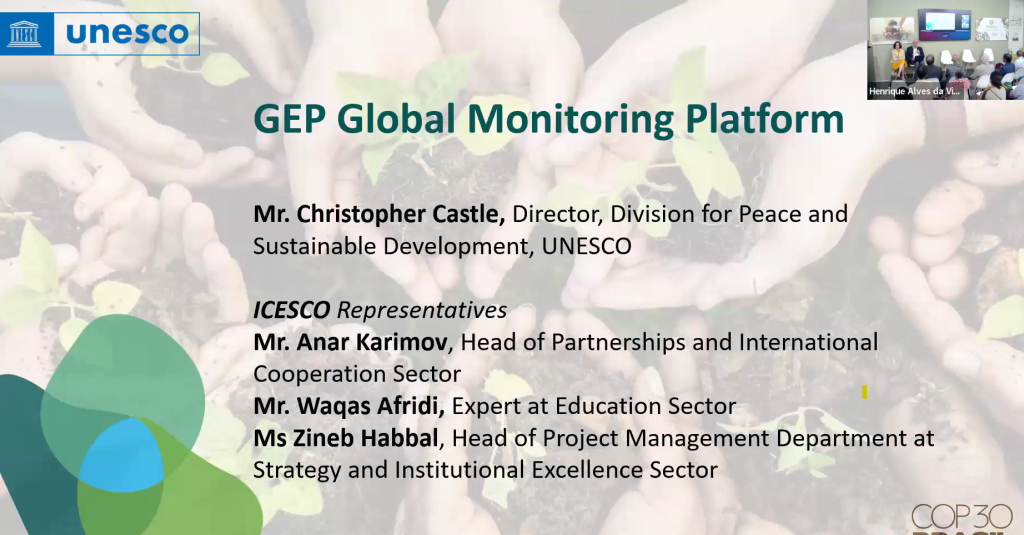
A new global dashboard co-led by UNESCO and ISESCO was also launched at COP30, providing a one-stop-shop for tracking progress across the GEP’s four key pillars: greening schools, greening curriculum, greening communities, and greening teacher training and education system capacities.
Maya Haddad: Driving Sustainability at Ajman University and Beyond
Maya Haddad’s participation at COP30 is the latest chapter in her extensive work championing sustainability in higher education. As AU’s Senior Sustainability Manager, delivered over a dozen impactful sessions on sustainable development and climate action.
Her leadership extends beyond the university campus. Haddad serves as Head of Operations for the UAE Universities Climate Network (UCN), a coalition of UAE-based universities committed to mobilising youth and academia in climate action. In this capacity, she has been instrumental in coordinating university delegations for COP30, organising joint workshops and panel sessions, and ensuring that Emirati voices are heard on the global stage.
At COP30, Haddad continued this mission, emphasising the critical role of young people in the climate movement. “The participation of youth in climate negotiations is not just symbolic—it is essential,” she said. “Universities have a responsibility to equip students with the knowledge, skills, and platforms they need to become the leaders of a sustainable future.”
Ajman University’s Commitment to the Greening Education Partnership
Ajman University’s engagement with the GEP reflects its broader strategic focus on integrating sustainability across operations, academic programmes, and community initiatives. The university’s Office of Sustainability has participated in multiple GEP working group meetings, contributing to the development of global standards and targets for greening education.
AU’s alignment with the GEP’s “Greening Communities” pillar is evident in initiatives such as the Mangrove Ecosystem Restoration event organised in collaboration with Al Zorah Development Company, as well as awareness sessions and workshops delivered by students on topics like climate resilience and environmental stewardship.
The university has also demonstrated its commitment through concrete institutional actions: it is one of only two UAE universities pledged to achieve net-zero emissions by 2030, and it has secured participation in pivotal global initiatives including the Nature Positive Pledge alongside the University of Oxford and UNEP.
A Call to Action for Higher Education
As COP30 concluded, UNESCO’s message was clear: the window for achieving the 2030 green schools target is narrowing, and the education sector must redouble its efforts. “Education is one of the most powerful tools in the global efforts to address the climate crisis,” said Stefania Giannini, UNESCO’s Assistant Director-General for Education. “We must ensure that every learner is equipped not only to understand the challenges but also to take action as part of the transition to a greener, more sustainable society”.
Ajman University, through the leadership of Maya Haddad and the Office of Sustainability, remains steadfast in answering that call. By participating in COP30 and actively contributing to the Greening Education Partnership, AU is not only shaping the future of its own campus but also helping to build a global movement for climate-ready education.