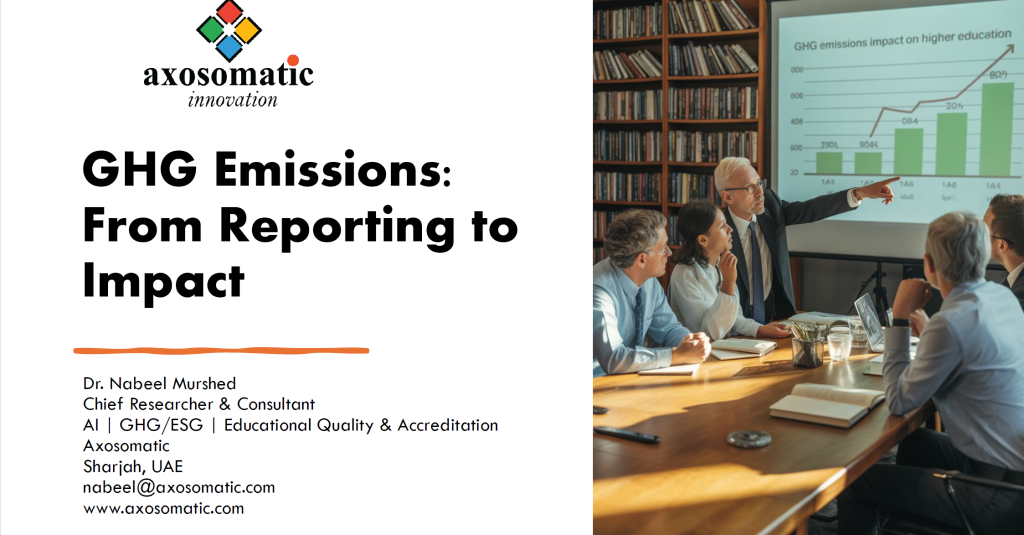
Ajman University’s Office of Sustainability Completes Advanced Training on GHG Emissions: From Reporting to Impact
The Office of Sustainability at Ajman University has successfully completed a specialized capacity-building workshop titled “GHG Emissions: From Reporting to Impact.” Delivered by Dr. Nabeel Murshed, Chief Researcher and Consultant at Axosomatic, the training was designed to equip higher education institutions with the advanced frameworks needed to transition from compliance-based sustainability reporting to impact-driven transformation.
The workshop addressed a critical challenge facing universities today: how to bridge the gap between sustainability data, institutional strategy, and measurable real-world impact. While many institutions have improved their data collection and emissions reporting under frameworks such as GHG, ISO 14064/67, GRI, and SBTi, they often continue to operate in data silos or treat sustainability as a side project.
Representing Ajman University’s Office of Sustainability, Maya Haddad, Senior Sustainability Manager, and her team engaged in comprehensive modules covering the technical and strategic dimensions of climate action.
Key areas covered during the training included:
-
Advanced GHG & Life Cycle Assessment (LCA): Understanding Scopes 1, 2, and 3 emissions, carbon offsetting, and the life-cycle impacts of university operations, from purchased goods to employee commuting.
-
CSR, ESG & Materiality Matrix: Differentiating between corporate social responsibility and ESG frameworks, and learning how to construct a Materiality Matrix tailored to the priorities of students, faculty, regulators, and society.
-
Net-Zero Roadmaps & Strategy: Developing science-based targets (SBTi) and multi-phase plans to achieve net-zero emissions by 2050, including strategies for transitioning to renewable energy and green procurement.
-
Turning Data into Impact: Translating emissions data into multi-dimensional institutional impact—encompassing educational, operational, reputational, community, and governance factors.
A central focus of the training was overcoming common implementation challenges in higher education, such as data fragmentation, funding constraints, and resistance to change. The workshop emphasized the importance of strategic enablers, including strong leadership, student engagement as co-creators of sustainability, and the integration of AI-enabled dashboards for accurate tracking.
“This training was instrumental in equipping our team with the frameworks needed to move beyond just reporting our carbon footprint,” said Maya Haddad. “To truly lead in climate action, we must use our emissions data to inform strategic decisions, enhance our curriculum, and drive operational efficiency. We are now better positioned to turn our sustainability data into tangible, institution-wide impact.”
The workshop aligns with Ajman University’s broader commitment to advancing the UN Sustainable Development Goals, particularly SDG 13 (Climate Action) and SDG 17 (Partnerships for the Goals). By investing in the continuous development of its sustainability team, Ajman University is reinforcing its role as a regional leader in climate-conscious education and innovation, supporting the UAE’s national Net Zero targets.