News
Dr. Samer H. Zyoud-Led Ajman University Team Wins Third CCleanTech Hackathon 2025 with Innovative “EcoNano Water Treatment” Project
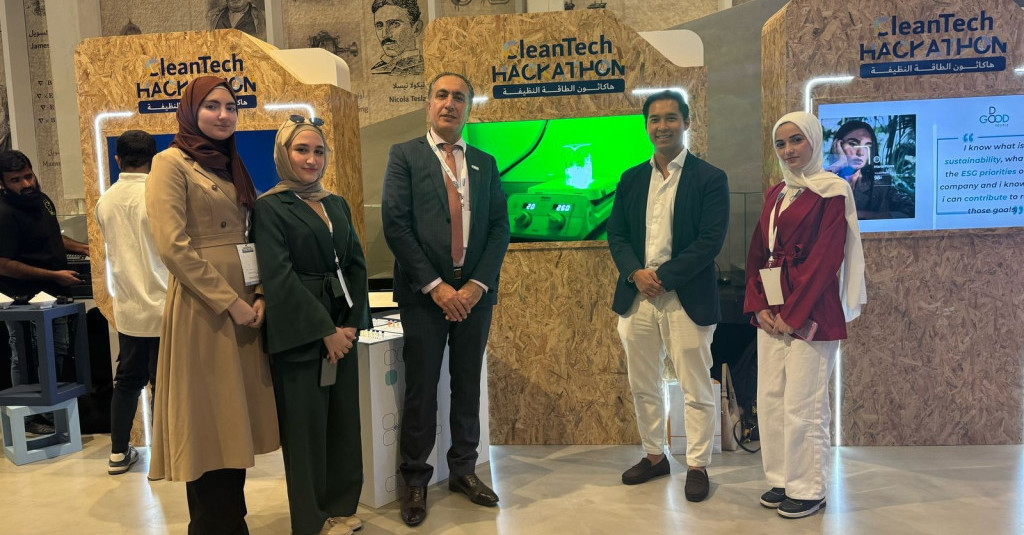
Cutting-edge nanotechnology solution earns recognition among five winning innovations from 193 applications across seven countries
In a remarkable achievement that underscores Ajman University's commitment to sustainable innovation and applied scientific research, a research team led by Dr. Samer H. Zyoud, Senior Lecturer in the Department of Mathematics and Science, College of Humanities and Sciences, has won the third CleanTech Hackathon 2025, organized by the Sustainability & Innovation Centre of the Dubai Electricity and Water Authority (DEWA) as part of the UAE Innovates 2025 initiative.
The team's groundbreaking project, "EcoNano Water Treatment," was selected among five winning innovations in a highly competitive event that attracted 193 applications from seven countries, bringing significant recognition to Ajman University's contributions to clean technology, environmental sustainability, and applied scientific research.
A Scientific Breakthrough in Water Purification
The EcoNano Water Treatment project introduces an environmentally conscious approach to water purification by integrating advanced nanotechnology, specially engineered metal-doped zinc oxide (ZnO) nanoparticles, and solar-assisted photocatalytic treatment.
The technology utilizes the photocatalytic properties of semiconductor nanomaterials to facilitate the degradation of organic pollutants and other contaminants in wastewater. When activated by suitable solar irradiation, these materials generate reactive chemical species capable of breaking down pollutant molecules, offering a promising alternative or complementary method to conventional water treatment processes.
The research builds on advanced synthesis and material-engineering approaches, including laser-assisted chemical bath synthesis, which enables the development of functional nanomaterials with tailored structural, optical, and photocatalytic characteristics.
The project's main scientific and environmental advantages include:
-
Enhanced contaminant degradation through advanced photocatalytic processes
-
Harnessing renewable solar energy for sustainable treatment
-
Reduced dependence on chemical-intensive treatment methods
-
Innovative approaches suitable for sustainable wastewater management
Student Engagement and Academic Mentorship
The project was developed under the research leadership and scientific supervision of Dr. Samer H. Zyoud, with contributions from Prof. Fares Howari, Dean of the College of Humanities and Sciences, and student researchers Bayan Alradi, Farah Thouqan, and Rand Anas.
This initiative exemplifies Ajman University's commitment to engaging undergraduate students in meaningful, application-oriented research that addresses real environmental challenges. Student participation provided an opportunity to connect classroom knowledge with advanced research concepts in nanomaterials, semiconductor physics, chemistry, photocatalysis, and environmental science.
Through the project, the students gained valuable exposure to scientific innovation, multidisciplinary collaboration, research communication, critical thinking, and the practical challenges of translating laboratory research into sustainable technological solutions.
Dr. Zyoud's mentorship and leadership were central to connecting the scientific foundations of the project with its potential environmental applications and positioning the team to compete successfully in an innovation-focused competition.
Building on a Strong Research Foundation
The technological foundation of EcoNano Water Treatment is supported by a broader body of peer-reviewed scientific research involving ZnO-based nanomaterials, laser-assisted synthesis methods, photocatalytic pollutant degradation, and antimicrobial applications. Related research conducted by Dr. Zyoud and his collaborators has examined how modifying semiconductor nanomaterials through metal doping can influence their structural, optical, photocatalytic, and antimicrobial properties.
The project's success illustrates the importance of translating published scientific knowledge into practical concepts that can address real-world water sustainability challenges.
Contributing to UAE Sustainability and Water Security
Water scarcity, environmental contamination, and growing demand for sustainable wastewater treatment remain major challenges for the UAE and the wider region. EcoNano Water Treatment contributes to addressing these challenges by exploring how nanotechnology and renewable energy can be integrated into innovative water purification systems.
The project has potential applications in the treatment of contaminated water, industrial wastewater, environmental remediation, and wastewater reuse, subject to further experimental validation and engineering development.
Its objectives are aligned with several United Nations Sustainable Development Goals, particularly:
-
SDG 6: Clean Water and Sanitation
-
SDG 7: Affordable and Clean Energy
-
SDG 9: Industry, Innovation and Infrastructure
-
SDG 12: Responsible Consumption and Production
-
SDG 13: Climate Action
Institutional Impact and Future Opportunities
Winning the CleanTech Hackathon strengthened the visibility of Ajman University's research activities within the UAE clean-technology innovation ecosystem. The recognition demonstrates the value of combining academic research excellence, student engagement, scientific mentorship, and sustainability-driven innovation.
The competition also created opportunities for greater interaction with researchers, industry specialists, investors, and other stakeholders interested in advancing commercially relevant environmental technologies.
Future development of EcoNano Water Treatment could focus on:
-
Optimizing photocatalytic performance
-
Assessing catalyst stability and reusability
-
Evaluating treated-water quality and nanomaterial safety
-
Developing continuous-flow prototypes
-
Establishing industrial partnerships for pilot-scale testing and technology transfer
Such developments could support the progression of the innovation toward practical deployment while contributing to Ajman University's objectives in research excellence, student innovation, sustainability, community engagement, and academia–industry collaboration.
Looking Ahead
The CleanTech Hackathon 2025 award represents an important milestone in student research achievement, faculty mentorship, and scientific innovation at Ajman University. Through Dr. Samer H. Zyoud's research leadership, the contributions of Prof. Fares Howari, and the active engagement of student researchers, EcoNano Water Treatment demonstrates how interdisciplinary academic research can generate innovative solutions to environmental challenges.
The achievement reinforces Ajman University's commitment to empowering students, advancing nanotechnology research, promoting water security, and developing sustainability-focused innovations with potential long-term benefits for the UAE and the wider international community.